Article by SSP Trade Union Organiser Richie Venton, originally published in the National 28/04/2026
AN encounter with an intelligent working-class woman at Saturday’s Scottish Socialist Party (SSP) campaign stall in Falkirk brought several issues to mind. The conversation went like this: “I agree with everything you say, but how are we going to get it?”
“By building a mass movement, of tens or hundreds of thousands of people to force the government into taxing the wealthy, to make them take energy companies into public ownership and cut bills. Having socialist MSPs would help.”
“But there’s always going to be a small group at the very top who will resist everything we want.”
“Absolutely! That’s why we need a mass movement of working-class people power, not just reliance on politicians. And don’t forget, in the words of the poet Shelley, ‘we are many, they are few’.”
“Aye, you’re right there!”
Firstly, it emphasised the purpose of putting forward SSP candidates on all eight regional lists at the Scottish Parliament election – to get MSPs elected who would take up the cudgels on our socialist action plan, helping to spearhead demonstrations, protests and other engagements of working-class and young people to demand the radical changes – cutting bills, raising incomes and vastly improving universal public services – which the SSP manifesto proclaims.
Our MSPs would not sit passively in Holyrood. They would champion socialist measures and help mobilise people in collective action to achieve those changes, even within the straitjacket of devolution.
Secondly, it reminded me of decisions at last week’s STUC congress and the crunch question of what trade union leaderships are going to do to achieve the many laudable goals agreed by delegates who represent 600,000 organised workers.
Many very good policy decisions – including ones which correspond to the SSP’s socialist aims – were agreed. An end to outsourcing of public services, which drains £3 billion from public resources into the pockets of profiteers, many of them in overseas tax havens. Or uniting workers for a better future in opposition to divisive, racist forces. Or increased expenditure on welfare rather than warfare.
These are all entirely laudable but the unavoidable question must be posed – what do the leaders of Scotland’s trade union movement plan to do to mobilise the potential collective power of 600,000 organised workers – plus their families and communities – to achieve progressive change? Let me focus on (and echo) the justified frustration and anger expressed by STUC general secretary Roz Foyer at the abysmal failure of politicians to take action to abolish “the illogical and regressive Council Tax”.
The Council Tax was the rushed replacement for Margaret Thatcher’s hated flat-rate poll tax. This son-of-the-poll-tax has punished low and middle-income families since John Major brought it in in 1991, after the mass non-payment movement of 18 million people – led by founding members of the SSP – toppled Thatcher and binned the poll tax.
In the 35 years since, Scottish Labour politicians and Labour-affiliated union leaders have shielded the iniquitous Council Tax from criticism and calls for its abolition, specifically made by the SSP.
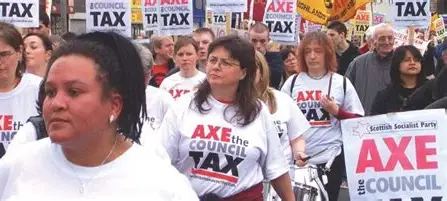
Since their formation in 1998, the SSP have fought relentlessly to “Axe the Council Tax” and immediately replace it with our progressive, income-based Scottish Service Tax. Eight out of 10 people would pay less but it would double tax funds for Scotland’s 32 local authorities by massive increases for the super-rich.
We’ve fought for this on street campaign stalls, in unions and workplaces; organised a national demo in Glasgow; and proposed a parliamentary bill when we had MSPs. Seeing the popularity of this SSP battle cry, the SNP made Council Tax abolition a flagship manifesto promise in 2007, winning a massive mandate to scrap it.
But 19 years later people are still saddled with it. The words of politicians have not been turned into action, which breeds scepticism, even cynicism, and fuels the fires of Reform UK’s Thatcherite chancers who plan to make things infinitely worse with tax cuts on the super-rich, slashing £150bn from public services.
When the STUC leadership announced they were calling a summit to pursue replacement of the Council Tax, my immediate reaction was: “It’ll take summat more than a summit!”
That is especially the case if the summit is restricted to the very same politicians the STUC rightly accuses of “political cowardice”, alongside a handful of poverty experts from Oxfam, the Poverty Alliance, et al.
Where are the “summits” of workplace union reps and working-class communities, or the public meetings, rallies and demonstrations to bring the hot breath of those hammered by the Council Tax on to the necks of MSPs who should and could be pounded into replacing it?
When the STUC speaks of “calling on all parties to step up to the plate and join the summit”, do they include the Tories and Reform UK but exclude the SSP, the one (and only) party which for 28 years has fought for a progressive, fully-costed alternative? Why rely on parties which have invented, defended, or repeatedly failed to scrap the Council Tax to suddenly become our saviours? Surely the core of a serious campaign to Axe the Council Tax should draw on the experiences which led to the downfall of the poll tax and its chief architect, Thatcher?

It was the organised collective power of working-class people which won that historic victory – led by many of us who later founded the SSP. The STUC of the day opposed our mass non-payment strategy and limited their “Stop It” campaign to the likes of a 15-minute stoppage in September 1989, after which they instructed workers to get back to work – a glorified tea break!
In a Scotland where the 10 richest families hoard at least £24bn, there is absolutely no excuse for a million Scots living in poverty. But, as the woman in Falkirk asked me, how are we going to get it?
Scottish Socialist MSPs would push Council Tax abolition and taxation of the rich and big business to the fore inside Holyrood, while building mass demos and protest movements of the working-class majority outside it.
The STUC could play a pivotal role, provided it brings “the people” into its plans and embraces the party which has living experience of the mass movement that axed the poll tax, which we are ready and eager to unite with others in applying.
That’s why having socialist MSPs would make a difference. To use Shelley’s battle-cry: “Rise, like lions after slumber/In unvanquishable number … Ye are many, they are few.”