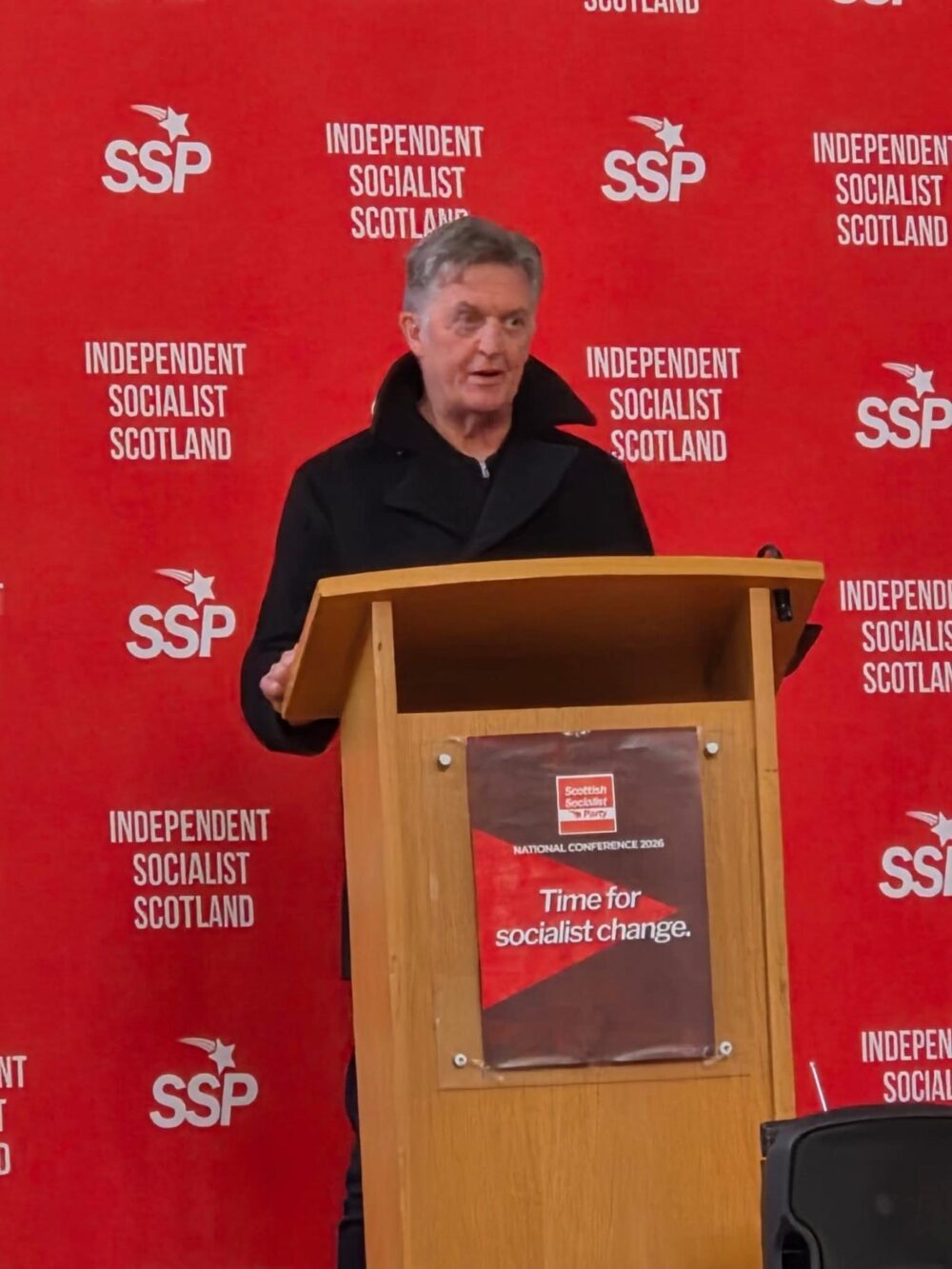
Below is transcript of SSP Trade Union Organiser Richie Venton’s speech to SSP conference earlier this month. An audio recording of this speech and a downloadable PDF can be found at the bottom of this page.
Whilst presenting the Executive Committee statement, Richie delivered this wide ranging and analytical speech about the goals of the SSP and the political context in which we are organising. This statement covers – amongst other topics – the protests spreading across Europe, the encroachment of AI data centres upon our communities, war and genocide in the Middle East, and the failures of the Burnham government.
Originally delivered by Richie Venton 14/11/2026.
It’s Time for Socialist Change!
Comrades, I would say that the capitalist system we live under is ripe, rotten ripe, for socialist change.
You see that worldwide in the cost-of-living crisis, the catastrophe with the climate, the wars without end, accompanied by a crisis of political representation for the working class, with the capitulation of social democracy internationally to the open capitalist camp for the past couple of decades.
World events underline, in scarlet red, the urgent necessity to build mass socialist parties. That’s the recurring theme of the Statement we’ve put forward from the SSP Executive Committee.
World economic crisis
Now it’s been said in the past that politics is concentrated economics.
When you look at the state of the world economy – without having time to elaborate – it’s featured by two main things: stagnation and inflation.
Stagnation in the sense that any anaemic growth that capitalist economies have had is based on two main things in the past year: shale fracking in Canada, and investments in the AI bubble in United States, where about a third of all investment has been in that industry.
And we’ve seen in the last couple of weeks, two separate days when the AI bubble began to burst, and on each occasion, one trillion dollars was wiped off the value of the ‘Magnificent Seven’, of the Big Tech billionaire companies that are involved in that sector.
Of course, the consequence could be an even worse world crisis in the economy than occurred after the dot.com bubble burst in 2000, or the financial crisis of 2008. The cost-of-living crisis, which flows from that and inflation, is well known to us. I don’t think I need to elaborate greatly.
And it includes the collapsing state of public services, not unique to this country, but worldwide, particularly since the crisis of 2008 and the imposition of austerity ever since, to pay for the bailout of the banking system, and of course more recently, the bailout of big business during Covid-19.

End of the post-1945 settlement
After the Second World War, there was a settlement which involved vast concessions to the working class. It included, generally speaking at least, the liberal democratic face of capitalism being prominent. But increasingly that facade is being abandoned for more authoritarian, dictatorial forms of rule. Although the capitalists in most countries don’t have the power, the social base, to impose outright dictatorships, at least in the majority of cases.
However, what they have been involved in increasingly is dragging back – stealing back – the concessions that were won in the post-1945 period by the working class.
They’re increasingly involved in trade wars and in outright wars. That’s been exacerbated by the fact that American imperialism is in relative decline as a unipolar world power compared to the brief period it enjoyed that status after the collapse of the Eastern bloc states.
We see now the fact that they’re increasingly concentrating on national war economies being constructed, which takes away from welfare, which takes away from the public sector.
And, of course, wars themselves add to the cost-of-living crisis, as we see with the war on Iran, blocking supplies, which will feed through (it’s not fully done so yet) in the form of increased prices for things like food and other essentials.
The ‘centre’ cannot hold!
We see alongside all this the utter failure of the so-called ‘centre’ parties to provide for the masses internationally, including in this country: centre parties including the likes of Labour and the SNP, close to home.
It brings to mind the words of the Irish poet W. B. Yeats:
“Things fall apart / The centre cannot hold / Mere anarchy is loosed upon the world”
It’s capitalist anarchy, the anarchy of wars, the anarchy of racism.
Of course, we’ve seen increased far right and racist forces internationally and at home.
But I want to emphasize the strong belief I have that it’s not just a uniform drive towards the far right, but an extreme polarization in society that we’re living through.
An extreme polarization in which the harsh choices increasingly are between the barbarism of the racist far-right, and socialism.
That’s the kind of overall task that we face in the years ahead.
Every continent erupts in revolt
Now, up until recent weeks, there were many merchants of doom on the left who said we’re on the road to a hell of fascism without resistance. But when we look at what’s happening currently, surely that’s an answer to just straightforward black or white pessimism, because we see a world uprising of young people and workers.
I haven’t time to elaborate and describe it all but let me put it this way: the geographical range of these struggles is far greater than it was in past revolutions.
In 1848, there were revolutions across Europe – and some movements elsewhere, but it was mostly European. Now we see that on every single continent, there’s been massive uprisings and struggles. Including, for example, the overthrow of dictatorships by youth insurrections in Nepal, Bangladesh, Sri Lanka; and challenges to governments like Indonesia, Philippines, and India by such movements as well.
Youth rebellions and workers’ general strikes
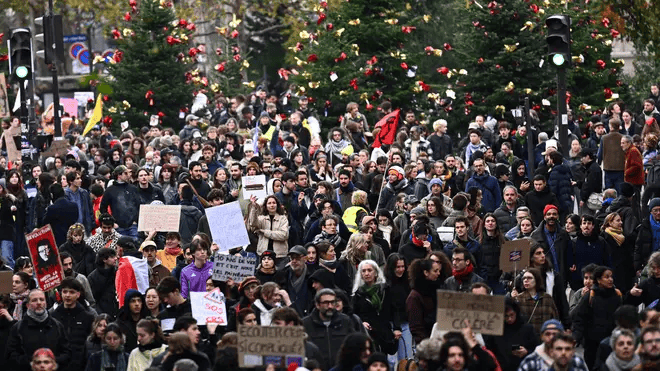
We see closer to home the scale of struggle, in Europe. The way in which there’s hundreds of thousands on the streets – and of course increasingly a feature of that struggle is general strike action by workers. Even in the last few days we’ve seen that in Spain with something like four million workers taking part and hundreds of thousands – estimates of four to six hundred thousand – in Barcelona and Madrid marching against various issues.
I think what that represents is an awakening from its slumber the giant of the working class. The organized working class – who were not the first to go into action on most occasions, it was what you might call the light infantry of students and youth, but now it’s been joined by the heavy battalions of the organised working class in those mass movements.
Sparks that light conflagrations
Another feature of it – and there are common features in different countries – a spark that lights a conflagration.
The collapsing of a railway station that killed people in Serbia and triggered two years of protest, which led to the election of the Student List there recently; or the eviction of an 87-year-old woman in Spain, which led to a mass movement on the housing issue which then turned into other questions as well; or the crisis in education, in schools in particular, in France, which has triggered the youth uprising in that country.
But it’s gone beyond that.
Because when people go into struggle, they begin to think of other associated issues.
Any of the interviews I’ve read or listened to by people in these different countries have shown that they’re also fighting on a whole array of questions, regardless of the original cause.
Such as on the question of workers’ wages, public services, education, health, housing; but also, against authoritarianism, against racism, against wars, against arms to Israel with, for example, strikes by port workers in 115 different ports recently against war and the sales of arms to genocidal Israel.
It’s right to say that Gen Z, as people have become known, are not the first generation of youth and students to rise in mass protests, considering the anti-Vietnam war movements of the past; 1968 in France and elsewhere; or the movements against the invasion of Iraq in more recent history. And they’re also not the first occasion when the youth moved first, the student youth for example, and then the workers came into action, with the far greater power that that represents in society.
The missing factor: mass socialist parties
But critically, another feature today, as well as in those past mass movements, is the need for – and the absence of – a mass socialist party.
Genuine revolutionary forces that help to give a vision, that give tactical and strategic leadership in those struggles, in determined struggle for class power, to bring the working class into power. Because in the end, let’s not mince words, it’s which class is in power that will determine the future of society!
France 1968, Iran 1979, Arab Spring 2011…
In France, 1968, which was a far bigger movement than is currently in France at the minute, with 10 million on a general strike, we had the situation where the social democratic and Communist Party leaderships – mass parties at the time – restricted that movement to minor reforms and concessions, when actually it was an opportunity for the working class to take power with de Gaulle [the French President at the time] fleeing the country with the expression “The game is up!” when he went to military bases in Germany for help.
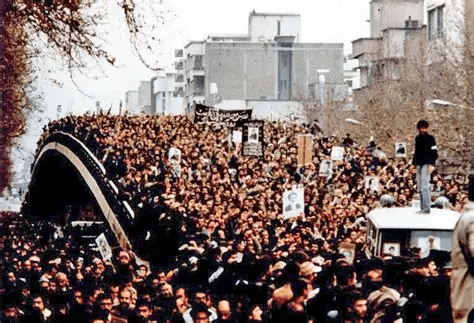
Or in Iran 1979, with the mass movements that overthrew the Shah’s dictatorship, but the absence of a mass socialist party led to the theocratic dictatorship of the Ayatollahs instead.
Or the Arab Spring of 2011, which overthrew dictatorial governments, including, for example, Mubarak in Egypt, but the absence of a mass socialist party led to the victory of the Muslim Brotherhood and, in turn, the Sisi dictatorship in that country, which of course do not represent the interests of the masses.
Celebrate victories – but stay sober!
We can celebrate recent victories, but I think we need to avoid becoming drunk with celebrations, so to speak!
Because the celebration includes the thumping defeat of Trump in the recent mid-term elections, but if, or rather when the Democrats – as somebody said, the other cheek of the same arse when it comes to capitalist parties – when they fail to meet the expectations of people who voted against the cost-of-living crisis, against data centres, against the far-right wars of Trump and so on, when they’re disappointed, there is a danger of a revival of far right capitalist forces.
Likewise, in Brazil. It was the multi-millioned masses going onto the streets which gained an extra ten million votes against Bolsonaro and in favour of Lula. But if – or rather, when – Lula fails to transform the lives of working-class people, those right-wing forces could again resurrect on a big scale.
What next after general strikes?
There are general strikes in France and Spain – and also Italy and other places. But those movements will soon face choices of who to vote for on the 29th of November in Spain, or in April in France. And is there any genuine force of socialism available?
The danger is it’s a battle – in the case of Spain – between the right-wing coalition of the People’s Party and Vox against a ‘left’ of Social Democrats who actually have helped to trigger this revolt by their failures to meet the needs of the people on housing and other questions.
There’s no shortcut to power for the working class. It requires well-trained, well-informed, conscious mass socialist parties rooted within the working class.
We don’t desire to be a discussion club. We’re not an academic, learned seminar. We are required to build a class struggle socialist party, which can put socialist ideas in the language of everyday struggle, that people can relate to and then bind that to mass movements.
That’s our ambition. That’s our self-definition of the SSP: a class struggle socialist party. The key question is how to build it.
Now, we need to get our bearings internationally and domestically in terms of what’s going on in politics. That’s what we try to do in the Statement.
We need to do that and then apply ourselves with our socialist principles as a consequence.

Burnham’s Labour will NOT ‘end 40 years of neoliberalism’
In the case of this island we live upon, Burnham’s government will not end 40 years of neoliberalism. We can see that in their choice of Cabinet. In their adherence to ‘strict fiscal rules’. In their preparations for an assault on the incomes of the sick, the disabled, or neurodivergent people, young people in particular. Other generations, like the triple lock on pensions, are being attacked. All because the government relies on a mythical economic growth in British capitalism, which is not about to arrive.
Also, we see the minuscule concessions that they make, which of course we can seize advantage of, on things like organizing rights in workplaces and so on, but we need to burst the Burnham bubble and explain what the realities are and put forward a hopeful socialist alternative.
Because what has been predicted by economists for this Burnham government is the worst decade in terms of the fall of living standards that there’s been in history – that’s actually the forecasts of the last few weeks from economists.
Burnham’s attempt is to build a war economy; that’s his answer to the problem. He’s tried to build up semi-hysteria amongst the population by telling us all to stock up, stockpile for three days of crisis. Presumably, the Russians are coming! Presumably, we’ll need enough baked beans and maybe gherkins, given that they’ve cut the price of them!
This stupid attempt to whip up a war atmosphere is an attempt to stop resistance to the turn towards warfare rather than welfare in the population.

SNP charges to the right
But then the question is, what about the SNP?
They’ve won an incredible, unprecedented fifth period of office recently. But, as I said in our column in The National this week [10 Nov 26] whilst millions internationally are moving to the left in a broad sense, the SNP is swinging to the right!
We’ve seen that in the way that they’re increasingly pivoting towards support for extraction of oil and gas, support for the fossil fuel capitalists, opposing the windfall tax on fossil fuel by the Labour government, opposing Labour’s talk about putting a ban on any new extraction of oil and gas – that’s an indication of their swing to the right.
As is their increased devotion to the introduction of data centres in Scotland – as with Trump: “He who wins AI, wins!”, that kind of philosophy – regardless of the consequence in terms of the environment of working-class communities and so on.
Increasingly also they are echoing some of the war propaganda of the Labour government in the utterances of people like John Swinney.
In fact, I would say, to put it in summary, that there’s very little ideological distinction between the SNP and Andy Burnham, apart from the national question.
Struggle, solidarity, and socialism.
That therefore raises the issue, how do the SSP pitch a clear fighting socialist alternative to the population?
I think, as with all our 28 years of history, a good starting point is our founding motto of struggle, solidarity, and socialism.
There’ll be no rapid development of socialist consciousness without large-scale or mass struggles, during which people learn rapidly in days what otherwise years would take to learn in discussion.
So any struggle that occurs on a progressive issue, that’s where the SSP needs to be.
To learn from those struggles, to aid them, to make them bigger, to make them more successful, to show that we’re the most devoted in building solidarity, to enhance and deepen people’s understanding of the class nature of society and therefore enhance their class consciousness, to develop a wider understanding of society during those struggles.
But in building that solidarity within those struggles, our duty also is never to stop telling the truth and to spell out the links, skilfully, between the immediate struggles they’re involved in and the bigger need for overall socialist change, which I’ll quickly illustrate with a couple of examples. Real, live examples; which I hope comrades from different branches that are involved in these struggles can bring in more description of that.
University strike-wave
There’s a spate of strikes at universities. In building solidarity with those workers, publicising the workers’ cause in different forms of media and so on, and being on their picket lines and discussing with them, we advocate full public funding rather than reliance on overseas student ripoff fees or increased reliance on big business.
Including, in the case of Edinburgh, Glasgow and Strathclyde universities, being part of the new Universities Defence Alliance that was set up in July, in other words ensnaring the university sector with the arms industry.
We argue instead for full public funding through measures like a wealth tax, progressive taxation, and so on.
And we go beyond that to demands to ‘sack the board’ and have democratic elections of Boards of Management, embracing representatives from the trade unions, students, local communities, councils, and government – to have socialist education hubs that actually represent the needs of society and not the profiteering ambitions of Vice Chancellors and the businesses that are embroiled in it.
Defying all cuts
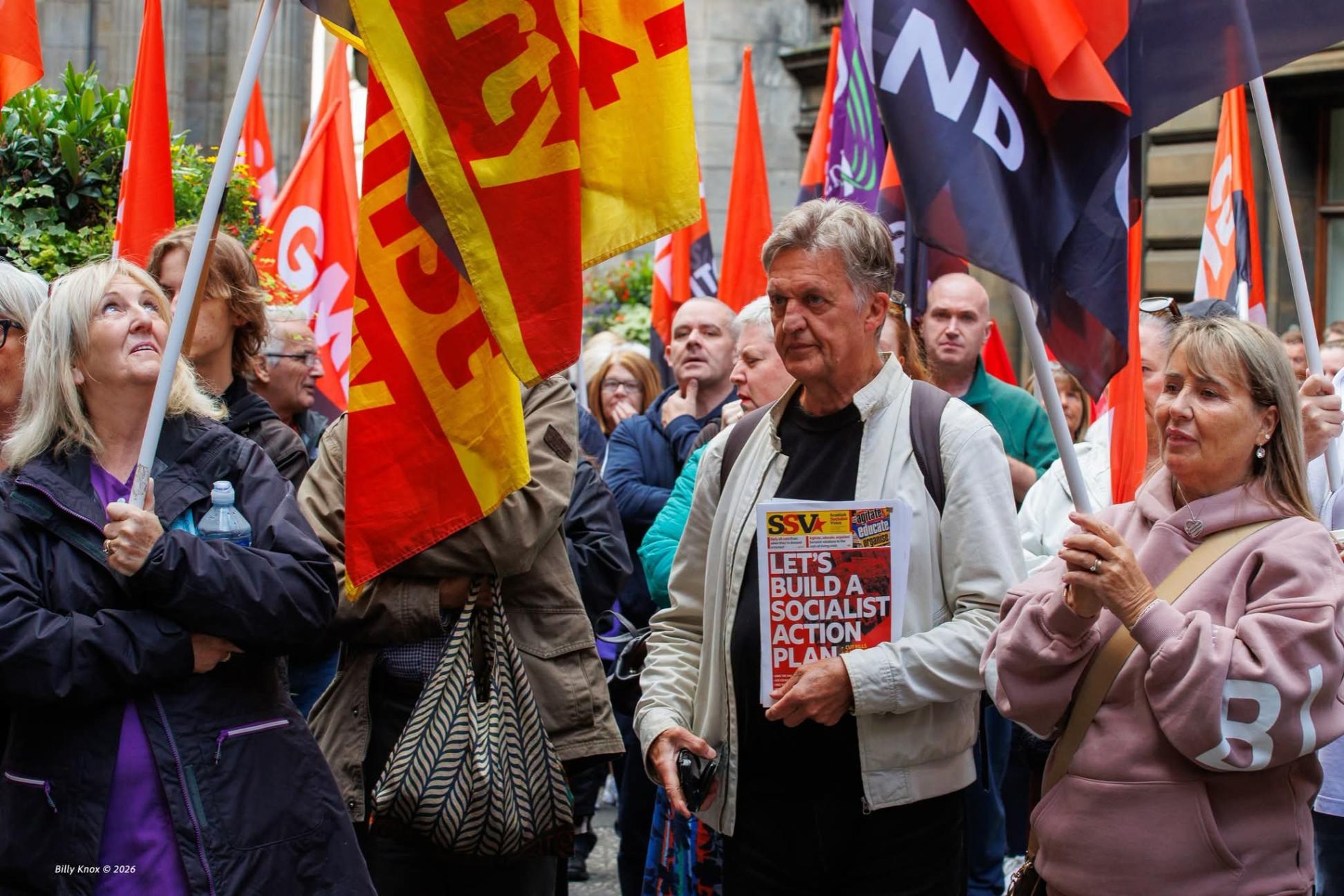
When we’re fighting against cuts of any kind, including obviously council cuts, of course we build support for those struggles. We earn the right to advise on tactics by careful involvement, including direct action methods of struggle. We make demands of councillors and MSPs. We make popular demands for ‘tax the rich’. We try to popularise our policy of the Scottish Service Tax within struggles against Council cuts. We campaign for No Cuts Defiance Budgets, using examples from past history (that I was directly involved in, in the case of Liverpool), and we use all of that to expose the shortcomings of the so-called ‘centre’ parties.
And then, of course, we need to advertise till the cows come home the way in which the SNP and the Scottish Greens have exposed their hand when it comes to sharp class conflict, by the fact that they were issuing dismissal notices to 24,000 council workers in Glasgow, under the use of the Tory anti-trade union policy of ‘fire and rehire’.
Anti-war, anti-imperialist struggles
When we’re opposing wars and genocide, we know that the chief task of socialists in this country is against our own ruling class, against arms sales to Israel, against the construction of a war economy, and we counter that. Because we need to, to convince, for example, workers across the street in the defence industry – in the shipyard – we need to counter it with instead the argument for public ownership of the entire defence industry in all its forms, so as to diversify into production for peaceful, socially useful purposes.
In other words, as I’ve said elsewhere, build ferries not warships; invest in nurses, not nukes.
We need to counter the propaganda of the centre parties, so-called, with concrete socialist alternatives.
Socialist change, not climate change
In combating climate change and the philosophy of ‘drill, baby, drill’ (or its coded version from the SNP), of course we need, especially in the context of things like Rosebank, to argue for public ownership – and the overall case for a Socialist Green New Deal, which we’ve shown could create 350,000 green jobs if you had public ownership of sectors like energy, construction, transport, and so on. [Order your copy of Socialist Change, Not Climate Change! here]
What I’m trying to illustrate is that we need to put forward clear fighting socialist arguments and slogans in the midst of building solidarity in struggles, so as to demonstrate that we’re worthy of the support of working-class people.
If I had time, I could give many examples of where we’ve done that, including in the last few days on the picket lines, as I hope our other guest speaker [Dr Naveed Hakeem, EIS-ULA Branch Convener at Glasgow Caledonian University] will perhaps convey to some extent this afternoon.
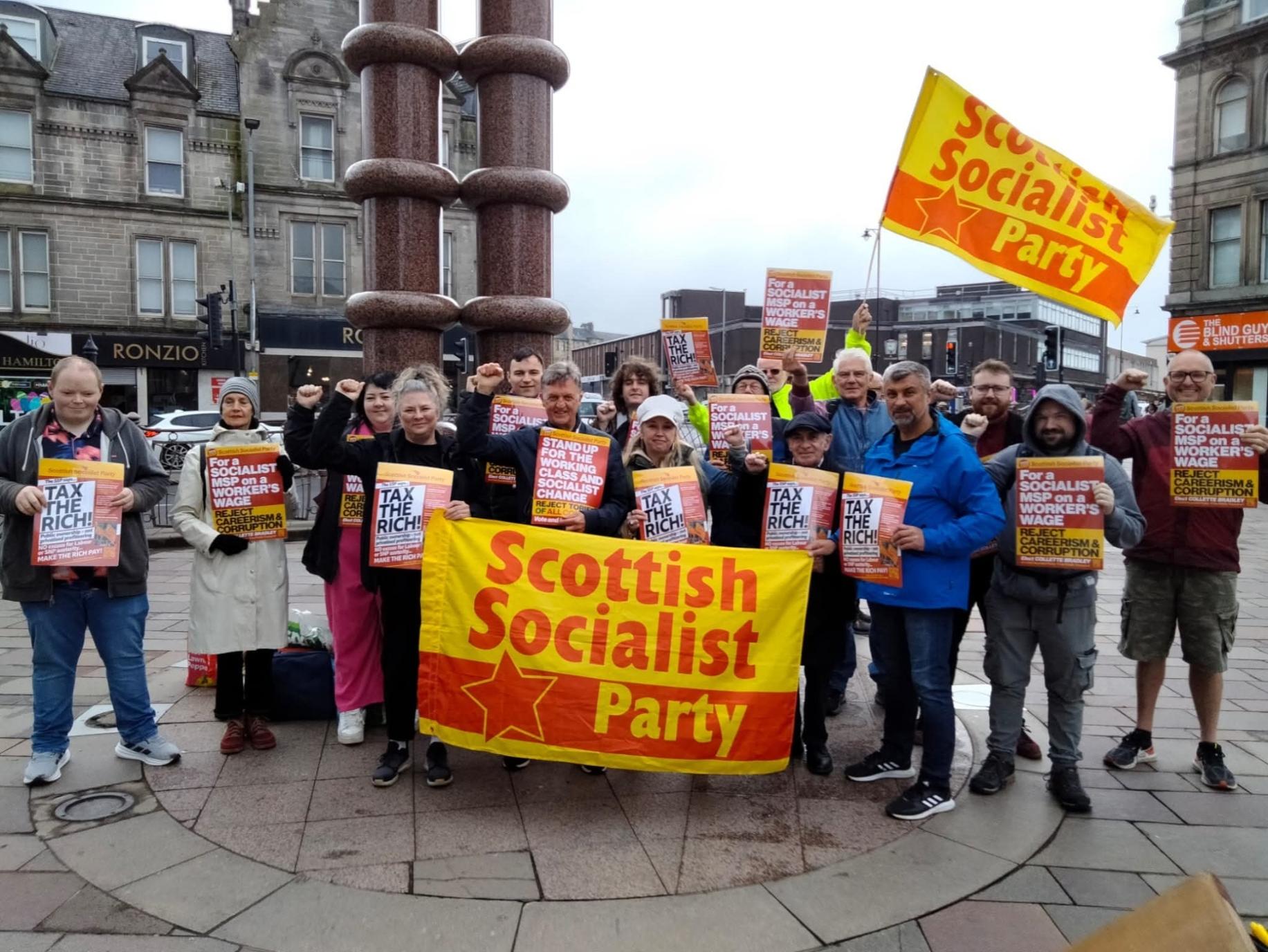
Socialist election campaigns
Those issues and others, keep the May council elections in their proper context and proportion.
We should stand in our own name in agreed, defined seats; not everywhere, but in selected seats.
We will advocate our core socialist policies relating to council questions in particular. Like axing the Council Tax for the Scottish Service Tax; no-cuts budgets; fighting for funds; building council houses; mass retrofit; free public transport; and other things. And we will try to popularise our name, our socialist policies, and recruit people during that election, as well as fighting hard – and it won’t be easy – but to try to get a toehold in the councils with the election of a few socialist councillors, with all the advantages that would give in terms of a platform for our ideas.
That is enhanced by my repeated, insistent, and persistent call for members to be involved on the street campaigning stalls, on the picket lines of workers, on the demonstrations of working-class communities; to be involved in the anti-data centre campaigns, putting our distinct position of condemning them for their environmental impact, but also raising the idea of democratic public ownership of Artificial Intelligence for the common good, so as to use of that for the enhanced benefit of the population and not for the profiteering of the Big Tech billionaires.
Unity in struggle, clarity in ideas
The Scottish Socialist Party strives for unity in struggle. But above all, I think we need to strive for clarity: the clarity of our socialist ideas.
We’re living in a new period of stormy upheavals that open up the opportunity for socialist ideas to gain currency.
When people look around in the midst of battles on housing, on health, on education, against data centres being built in their communities, or wherever it might be; when they’re on strike against job losses or pay cuts, whatever the immediate issue, our task is to put forward in a skilful, firm, friendly fashion that this is part of the cursed system of capitalism, which is causing a crisis for the millions, and we stand up for the millions against the millionaires with clear-cut, red-blooded socialist alternatives, put into concrete policies, explained carefully and sensibly.
The choices: socialism or barbarism
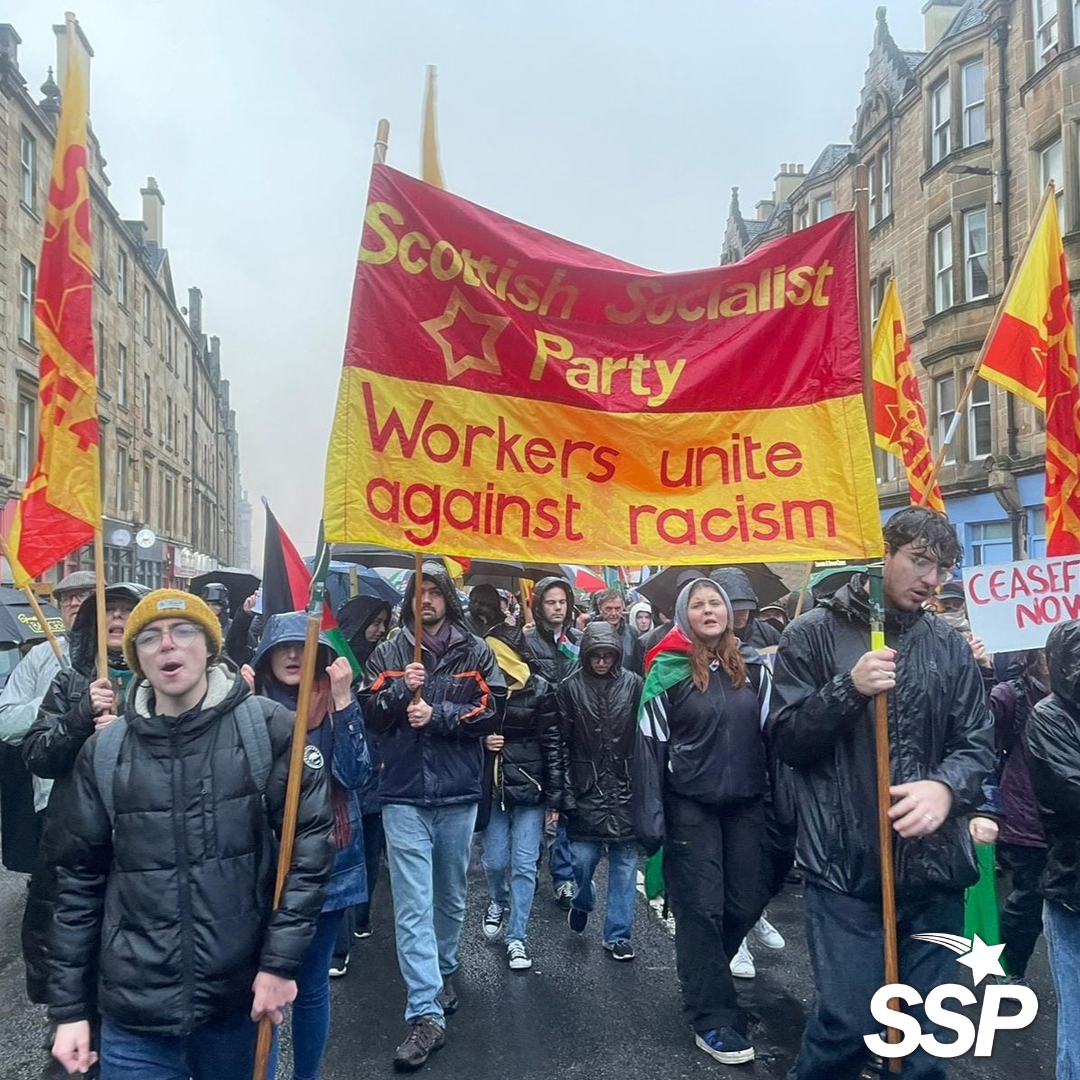
I’ve never believed in Scottish exceptionalism. It would be foolish to try to predict what scale and when exactly there’ll be movements akin to those a few hundred miles away on the European continent in this country. But mark my words: struggles will occur. Struggles are already occurring. Whether it be the mass demonstration today in Edinburgh on data centres. Whether it be the strike picket lines that we’ve already been involved in.
But we should never lose sight of the fact that it’s an urgent task to build this Party, for every single member to be a Party builder, because we do face the choice between socialism and barbarism.
The socialism that could enhance humanity and bring it forward, saving the planet in the process; or the barbarism of cuts to living standards, far-right forces, and hell without end under capitalism.
Be determined. Be clear-sighted. Build this Party as part of that task.
Thank you.
AUDIO: