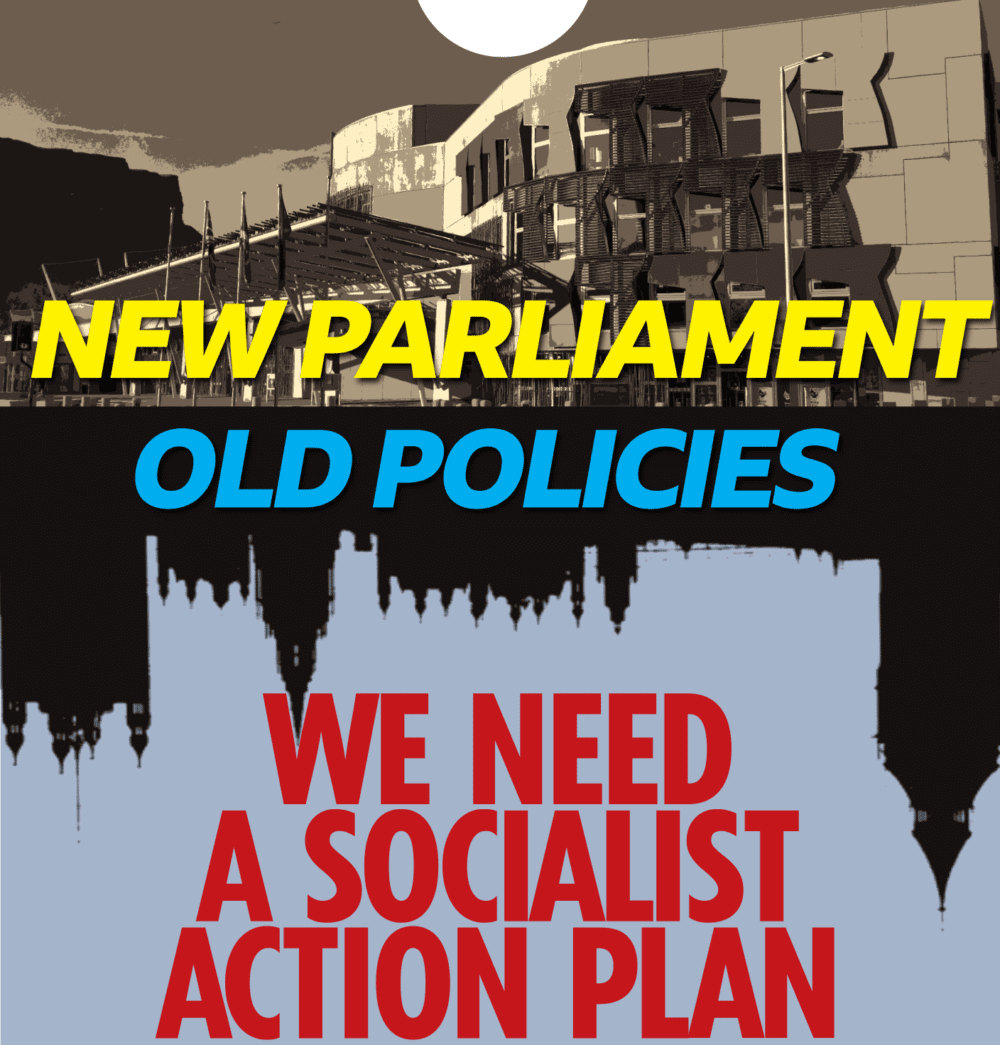
THE STRUGGLE CONTINUES – PART 2
A feature on the Scottish Election and its aftermath
By SSP election campaign organiser Richie Venton
We are carrying a series of articles, making up this feature, written two days after the Holyrood election results. In this, the second part of the series, we ask…
What comes next?
Given the parliamentary arithmetic, will there be a re-run of the SNP/Scottish Green Party coalition? I think not.
Both the SNP and Scottish Greens had their fingers burnt by officially sharing government responsibilities. The SNP’s popularity fell, and the Scottish Greens suffered internal dissent, faction fights and defections over the Bute House Agreement.
More to the point, the SNP don’t need to offer a coalition because the Scottish Greens’ leadership have demonstrated their willingness to help pass SNP cuts budgets for a few measly concessions, and the LibDems could also be points of support for what the SNP want to carry out.
Under the surface of the SNP’s 5th win
Most importantly, far from the fifth successive election of an SNP government being the signal of stability and ‘business as usual’, it is likely to usher in a period of increased turmoil and conflict.
The SNP escaped greater scrutiny this time round because there was no wave of class struggles to expose them in action – unlike the firefighters’ strike and mass movement against Blair’s invasion of Iraq on the eve of the 2003 Holyrood elections, which exposed New Labour and were the driving factors behind the Scottish Socialist Party winning six MSPs.
As we warned throughout the campaign, including in our manifesto, the incoming Scottish Government faces a predicted financial black hole of at least £4.7 billion by 2029, which threatens up to 20,000 public sector jobs.
As we accused them in press releases, the mainstream parties hid their plans to wreak havoc on jobs and public services behind the backs of voters. John Swinney, in a whispered aside at the early stages of the campaign, admitted at least 11,000 jobs would have to be chopped. Nothing was made of this by their Labour opponents, or others, apart from the SSP.
Defiance or compliance with cuts?
Why? Because that black hole can only be filled in one of two ways. It can be tackled by measures advocated by the SSP: a 5% wealth tax on all millionaires; progressive taxation of the super-rich instead of the regressive, punitive Council Tax; and public ownership of key sectors, including profitable ones like energy, construction, transport and banking. Or else the books will
be balanced by butchery to workers’ jobs and vital services in working-class communities. The latter is the road the SNP government will travel.
Which raises the need for active, serious, collective resistance by the biggest force in civic society, the trade union movement, with its 600,000 members – and the potential to recruit hundreds of thousands more by adopting a militant, fighting stance, and taking advantage of the concessions in Labour’s Employment Rights Act, which makes it a bit easier to access workforces for union recruitment and removes the high hurdles against collective strike action – including the need for a 50% turn-out and 40% vote for industrial action by all eligible members.
Unions need to lead resistance
The question is whether the STUC and other national union leaderships are prepared to face up to this task. Despite 30-40 years of anti-working-class atrocities by Labour since Tony Blair’s conversion of it into an openly, unashamedly capitalist party, too many union leaderships still cling onto the false hope of returning it to something akin to a friend of the working class.
But that delusion is increasingly being rejected by trade union activists and members. UNITE’s national executive has slashed affiliation funds to Labour by £580,000, with the growing likelihood members will force outright disaffiliation by UNITE, and other unions.
No trust in Labour’s New Tories!
Some union leaders will no doubt attempt to rescue Labour’s reputation amongst union members by replacing Starmer with alleged ‘soft lefts’ Angela Rayner or Andy Burnham, despite Rayner being quite content to be Starmer’s deputy during their assault on child benefits, winter fuel payments, betrayal of WASPI women, and arms sales to Israel for the genocide in Gaza.
The SSP will join with others to actively resist this fakery inside our unions, and demand the unions break from Labour, give members democratic choices of pro-trade union parties to fund, and help to build a mass working-class socialist alternative to Labour’s New Tories.