


SSP Co-Spokesperson Colin Fox’s article for the National, 08/08/2026, as part of their series on public transport in Scotland. Here, Colin expounds the SSP’s pioneering ‘Free Public Transport’ policy, and explains how it could transform Scotland’s public transport system.
I enjoyed reading James Walker’s article about his trip to Luxembourg (“I visited a country with free public transport. Can Scotland have the same?”, August 5) where he relates how the measure has been introduced to great effect there, in Estonia and in Dunkirk in France.
He could also have highlighted successful schemes in Hasselt in Belgium (the first city in the world to introduce free bus travel) as well as those in Salt Lake City and downtown San Francisco.
The question in the headline on James’s piece is one the Scottish Socialist Party asked in 2004 when we laid a bill with that intention in front of the Holyrood parliament. Sadly, it was voted down by the Labour-Liberal Democrat coalition and others.
Twenty years later, however, with a record-breaking heatwave and drought searing much of Europe, it is surely in need of reconsideration.
As I sat for a scorching hour in the car on City bypass last Tuesday on the way back from a family gathering in Bellshill, I was struck by how apposite such a bill remains.
Without wishing to diminish in any way the significant economic and health improvements our proposal would have delivered, it was one primarily driven by the need to reduce CO2 emissions and alleviate the serious threat climate change poses.
The years since our bill was laid have hardly reduced the need – quite the contrary.
Scotland could have been a world leader by backing our bill. Today, as James reveals, we are once again laggards in this regard.
Give people a better alternative to their car and they will take it – that is our central conviction.
Introducing free public transport – on buses, trains, trams, the underground and ferries – would get people out of their vehicles, reduce wealth inequalities and emissions, and significantly benefit the wider economy.
An approach to reducing CO2 emissions which gives people a better alternative to using their cars is bound to have improved results.
How much better it would be to avoid the twice-daily misery of commuting into and out of our major cities, sitting nose to tail in traffic jams in all weathers at both the start and end of your day?
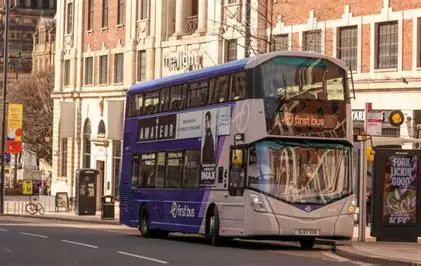
The transport secretary at the time our bill was introduced was Tavish Scott from the LibDems.
He told me then that the estimated cost of introducing free public transport would be £500 million per year, measured in terms of lost fare revenues.
I always felt this figure was too low as it did not include the extra transport and infrastructure required to accommodate greater demand.
On the other hand, neither did it factor in the savings to be made from a diminished road repairs budget, or from the health-related impact of lower pollution, or the reduction in the number of road accidents and the economic benefits accrued from the reduced congestion on the city bypass, the M8 or the Dundee ring road for example, as the overall volume of traffic on Scotland’s roads fell.
On ferries, I was disappointed to read that Stephen Flynn is talking about privatising the Fergusons shipyard and Prestwick Airport as soon as there is “market interest and profitability”.
Selling off government assets highlights for me the profound difference between the SNP’s approach and those of us who see public ownership as a route to putting greater wealth into the public purse, not pouring it out.
Moreover, I envisage free “public” transport schemes being “publicly” owned.
Instead of taking the lead on progressive, far-reaching initiatives, Scotland has lagged behind Luxembourg, Tallinn, Hasselt, Dunkirk, Salt Lake City and other cities which have forged ahead and introduced free public transport schemes in their jurisdictions with considerable success.
I’d like to see the provision of free public transport sitting alongside free personal care, free prescriptions and free tuition as the finest of Holyrood’s achievements.
And I’m not alone. It is a progressive idea whose time has come and Scotland needs leaders to rise to the challenge.
Read more: