


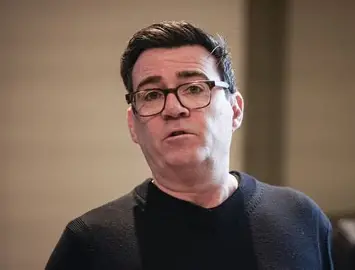
Piece by SSP National Co-Spokesperson Colin Fox originally published in the National Newspaper 08/07/2026.
‘WESTMINSTER has not been working for people,” declared Andy Burnham in his first major policy speech since Kier Starmer’s resignation. ‘I am going to do things differently. I will build a team of all the talents and reach out to other political parties.’ What? Even Reform?
This was to be sure not the only question arising from Burnham’s nebulous offering, his speech was littered with them.
“There will be more money for local councils,” he promised. “The days of Whitehall fighting the regions are over forever.”
More money? From where? He did not say.His promise to “launch the biggest social housing programme since the Second World War” undoubtedly drew most applause from his invited audience at the Manchester People’s Museum.
But he didn’t explain how he would raise the funds nor how he would remove any of the considerable obstacles to that goal he faces from the private housing market.
“Our 10-year mission to raise people’s living standards starts today,” he went on. “Our challenge is to build an economy with the working class in mind.”
Now where have I heard that before? Oh yes, from every Labour leader there has been. And yet each failed miserably to deliver such an economy!
His “10-year vision to raise living standards” involves “reforming utilities, re-industrialisation, and regeneration via public ownership of water, energy, housing and transport”; he declared again without offering a route map for any of it.
“Re-industrialisation,” I thought? Labour? They haven’t the slightest intention of doing so as the sums involved both in starting virtually from scratch and then competing with China, the USA, Germany, Japan or South Korea in any modern industrial setting are mind-boggling and therefore ruled out.
“Imagine,” he concluded, “housing for everyone, energy prices under control, good growth in every post code and hope in every heart. Let’s make it happen.”
Scots looking south trying to make sense of the self-styled “King of the North’s” attitude to a second referendum on independence, for example, will find it differs not a jot from Starmer’s. He is another true-blue Unionist, in his case Evertonian blue!
Dismissing independence, Burnham argues there is no difference between people in “Dundee and Dudley”, and that they have much in common, as indeed they do.
But he ignores the profound differences. Dundee is in another country, one with its own parliament, its own right to self-determination, its distinct political desires and different voting patterns.
Of those desires, he insists: “We will not leave everything to the market, there’s a place for [state] intervention.”
Here the member for Makerfield calls upon Labour’s social democratic heritage, one admittedly which its modern leaders have long ignored, consumed as they are by the directives of neo-liberal capitalism.
His “Manchesterism” promises “good growth” we are told. A confected phrase he uses repeatedly. “Good growth in every postcode in Britain” to be precise, a slogan his spin-doctors clearly designed for the 1pm news bulletins.
But this pledge is ultimately fatuous and lacks even an ounce of credibility. Leaving aside whether he will last two years Burnham’s plans are vague at best. “Britain can be the world’s innovation nation,” he airily proclaimed without explaining how.
Burnham, as a speaker is more empathetic than Starmer and better connected to the Parliamentary Labour machine to be sure, but like his predecessor there is not an ounce of resolve in him to confront “the powers that be” – the bond markets, the multinational corporations, the military industrial complex, Nato or the private housing industry.
His confected tension between London and Manchester is both juvenile and foolish, not least because one quarter of his MPs occupy London seats.
In the end he bottled out of the implied conflict, proclaiming London as “the greatest capital city in the world”.
At the same time Labour MPs clearly hope Burnham is the man to rid them of Reform UK particularly in the “red wall” seats of the North of England and the Midlands.
The early polls have shown an improvement in Labour’s fortunes for the man who rid us all of the unloved Keir Starmer. But that improvement has put him only 1% ahead of Reform [Labour 25%, Reform 24%, Tories 20%] which is statistically insignificant.
If he fails to deliver on the promises he has made that polling will undoubtedly see Labour sitting in even deeper trouble.
If, as is likely, his popularity falls to Starmer-type levels he is more likely to join the ranks of those other short-term lease occupants of Downing Street than the reverse.
Meanwhile, the “coronation” of Burnham robs John Swinney and the SNP of its biggest electoral asset (ie Starmer) and the Scottish Government will be called to account for their own failures in office.
Swinney’s decision to cut another £5 billion from vital public services in Scotland while posing no solutions to the cost of living crisis, may have profound political consequences here too. The truth is, of course, you could not honestly put a “cigarette paper” between the politics of Burnham and Swinney on the major issues of the day.
Burnham’s policy platform, vague as it is, could just as easily have been laid out by the First Minister.
Each is no more likely to bring forward workable solutions to the low growth, poor productivity, widening inequality, deteriorating public services, warmongering, social care crisis and imaginary “just transition” than Starmer.
“Plus ca change, plus ca meme chose”, as they say in French.