


SSP Co-Spokesperson Colin Fox offers an analysis of AI and wealth inequality, originally published in the National Newspaper, 29/09/2026
I wrote a piece for the Scottish Socialist Voice [see bottom of this article] recently making the case for a wealth tax. Instead of watching billionaires becoming trillionaires, I argued, we need to get them to pay more tax. We, as a society, need that money for example to provide jobs for our young people, to save the NHS from the worst crisis it has ever faced, to build a social care system we can be proud of rather than ashamed, and deliver the 100,000 new council homes we have been promised for the past 25 years.
Those wondering who the ‘super rich’ are might look at those invitees Donald Trump and Xi Jinping met at their state dinner in Washington DC last week. In attendance from the American side there were, in no particular order, Jeff Bezos from Amazon, Satya Nadella of Microsoft, Tim Cook from Apple, Jensen Huang of Nvidia, Sam Altman from OpenAI, Elon Musk from Space X, Sundar Pichai from Google and Anthropic’s Dario Amodei. Cumulatively the combined personal wealth of these gentlemen surpasses $3trillion. That’s three thousand billion dollars!
My article highlighted, among other things, the arguments most commonly offered by opponents of such a redistributive approach; that the rich will leave the country if we ask them to pay more, that we shouldn’t penalize ‘success’, that these ‘entrepreneurs’ create the nation’s wealth and work jolly hard for their money, that making the rich richer will mean their wealth will ‘trickle down’ to help the poorest most of all. Some even insist the rich pay most of the taxes as it is. None of this is true of course.
Under Margaret Thatcher in the 1980’s for example the UK Corporation Tax rate was 52p in the pound, today it is 25p.
The campaign, which the Scottish Socialist Party leads, to scrap the unfair Council tax and replace it with one based on income, and therefore on a person’s ability to pay, would see 60% pay less and the wealthiest Scots contribute more.
But lest you conclude it is only socialists like me who see the dangers, former CBI Director Adair Turner is among those ringing the alarm bells for society about the widening gap between rich in poor today. Writing in The Financial Times last week [25/9/26] he warned ‘AI is certain to exacerbate concerns about inequality’.
You can read my Voice article for yourself, I mention it here because my attention was drawn to a referendum due to take place in California on November 3rd. ‘Proposition 40’, as it is known, seeks to introduce a wealth tax on the profits of the big tech companies based in ‘Silicon Valley’.
California Referendum
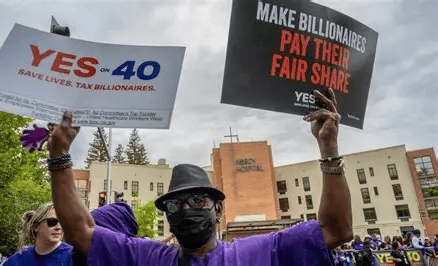
The plan, sponsored by the state’s biggest union [SEIU-United Health workers] is backed by California’s Democratic Party and enjoys widespread public support. Many of the world’s leading economists are among its advocates including Nobel Prize winners Joseph Stiglitz, Professor Peter Diamond and Daren Acemoglu.
California attracted 80% of all the venture capital invested in America last year. Google, Microsoft, Meta, Amazon and X are all based there as are AI giants Anthropic, ChatGPT and Open AI. Proposition 40 wants the state to introduce a 5% tax on the big tech firms to boost investment in improved healthcare and education. Some 60million Americans have no access to healthcare. And the fentanyl epidemic sweeping the US shows the consequences for a further 20million of a health insurance policy which limits their medical care to painkillers alone. This, in the richest country on earth!
Proposition 40 would compel the California state government to take in effect an equity stake in the Silicon Valley firms. The latest polls show support for it in the lead, but with the vote itself officially ‘too close to call’.
The plan is predictably perhaps opposed by the richest Californians. And they are organized behind the ambiguously named campaign group ‘Building a Better California’. Sergey Brin, co-founder of Google, has led the campaign and donated $100mn to their cause. Brin insists the measure is a ‘Trojan Horse’ for plans to increase taxes on everyone. California Governor Gavin Newsome, widely tipped to be the Democrats Presidential nominee in the 2028 race, has irked many of his own party’s supporters by arguing against the Proposition too on the grounds that it should be introduced at Federal level instead. The tactics of the ‘No’ campaign are hardly novel.
Many commentators predict there will be social upheaval if the impact of AI on society is to turbo-charge inequality still further.
Speaking at a Congressional Committee in August Senator Bernie Sanders referred to a Wall Street Journal report that revealed that 92% of all US stocks and shares are owned by less than 10% of the population. He is among many who fear such statistics will worsen with AI.
‘Qui bono?’ Who benefits?
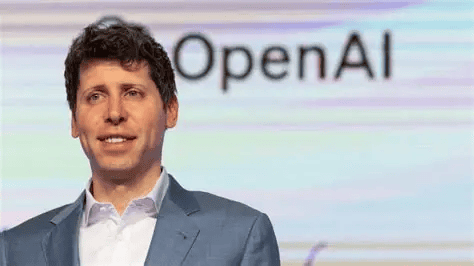
With mindboggling sums now being pumped into all these AI firms the wealth tax debate has morphed into a wider one asking who stands to benefit from this technological advance. Is it to be the oligarchs and billionaire owners of Nvidia, Anthropic, OpenAI and ChatGPT or the nine billion people on planet earth who will inevitably have to pay to access it as it transforms every aspect of life? This is surely the moral question at the heart of AI itself.
Read More: