


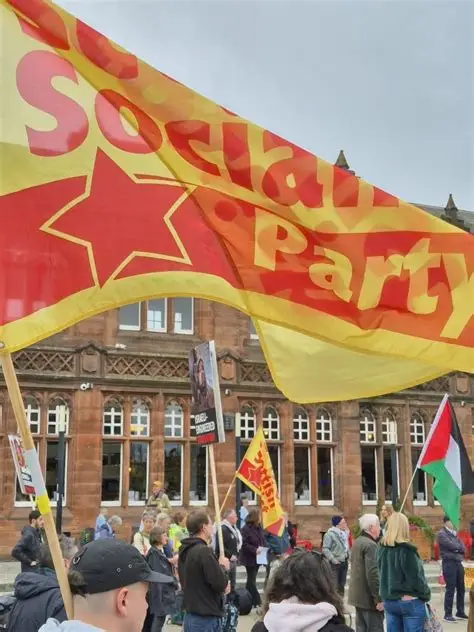
Article by SSP Co-Spokesperson and Lothians Regional List lead candidate Colin Fox, first appeared in the National Newspaper 14/04/2026
THE first two weeks of the Scottish Socialist Party’s election campaign have been a hectic whirlwind of door-to-door canvassing, leafleting, street stalls, public meetings, picket line visits, social media posts, podcast interviews, fundraising events and hustings.
It’s been great – I’ve thoroughly enjoyed myself. Joining the University and College Union (UCU) picket line at Edinburgh University and speaking at their huge strike rally in Bristo Square with their colleagues from Heriot-Watt was one highlight. As were the hustings organised by Unison’s Lothian Health Branch at Danderhall Miners Club, which gave me the chance to expose the record of both Labour and the SNP in selling off NHS hospitals in Scotland to private companies.
The response from people at the hustings, on the doorstep and at our SSP street stalls on Princes Street in Edinburgh has been really encouraging.
At the same time, I welcome this opportunity to reflect calmly on the mood of the electorate in an election overshadowed by the war in the Persian Gulf and its impact on the underlying cost of living crisis.
Averaging out the last 10 opinion polls would suggest the SNP are set to win 55-60 MSPs, Labour 15-20, the Greens 15-20, Reform 15-20, and the Tories and LibDems 10 apiece. Of course, all polls need to carry a “health warning” and there are still three weeks to go until the vote.
What does all this tell us about the political mood of the Scottish electorate?
First, we must again acknowledge that nearly half of people won’t vote, either because they don’t believe anything will change, or they don’t trust any party to represent their interests. And it tends to be the poorest and most marginalised who “abstain”, as it were.
But putting that aside for a moment, what are the apparent attitudes of the 55% who will cast a ballot on May 7? Who, for example, is voting for the SNP and why?
And how at 35% do the nationalists appear to be defying gravity in securing a near-majority in a proportional system designed specifically to prevent it? The widely expected outcome will, as others including Geoff Aberdein have pointed out, be remarkable if it happens, given that the SNP have been in government at Holyrood for almost 20 years.
Such longevity in Western politics is rare and normally induces a powerful desire for electoral change.
Moreover, the SNP have, to say the least, not had their troubles to seek in recent times. The court case involving financial allegations against former chief executive Peter Murrell is ongoing and the enforced resignation of the last two first ministers, as well as the loss of more than 50,000 party members, adds up to quite a litany.
In addition, they have not advanced the cause of independence one inch since 2014. At Holyrood, they have produced nothing in a decade to compare with the earlier big-ticket items of the abolition of NHS prescription charges, free personal care for the elderly and free tuition.
Taken in the round, the SNP should be set for a stint on the opposition benches where they were from 1999-2007. But apparently not. They have undoubtedly benefited from the revulsion, if not outright sense of betrayal, felt across Scotland toward Kier Starmer’s Labour Government. And the long-held contempt for the Tories has not disappeared either.
Just as significant, however, for me, is the SNP’s apparent role as a “safe haven” for those wishing to halt the rise of Reform UK here. This important factor has not, in my view, been sufficiently understood by the mainstream Scottish media.
Whether the SNP deserve such an accolade is, of course, quite another issue. But I know many people on the political left in Scotland who, if not quite “holding their noses” are reluctantly voting for the SNP solely to stop Reform.
Paradoxically, the SNP’s strategy of seeking both votes on May 7 plays into the hands of Farage perfectly. It will secure the SNP virtually none of the crucial regional list seats. And yet, were these ballots deployed more deftly they could neuter Farage.
Many have agreed with the point I made in a previous column, that our Unionist opponents would undoubtedly avoid such a blunder were the shoe on the other foot in these circumstances.
Having said all that, John Swinney’s greatest difficulties will undoubtedly emerge after the election when his inability to deliver on the cost of living crisis, independence and the many other challenges we face will again be exposed.
Those who demand the SNP offer real resistance to Westminster austerity, neoliberal inequality and warmongering will not be patient forever.
Many of us remember, for example, how the SNP argued that the poll tax was the law, and it had to be paid – just as Labour did. Some 16 million defied them both and defeated Thatcher’s flagship policy.
One thing we can all agree on, however, is that the cost of living crisis is not going away. The Organisation for Economic Co-operation and Development (OECD) is predicting that inflation will double in 2027. Unemployment and under-employment are already on the rise.
And the role the Scottish Government plays in that crisis will be severely tested in the months to come as far as working people are concerned.
Business as usual is the last thing the electorate is voting for.
Nor is it something that they will tolerate in the circumstances from yet another timid, visionless Scottish Government.