


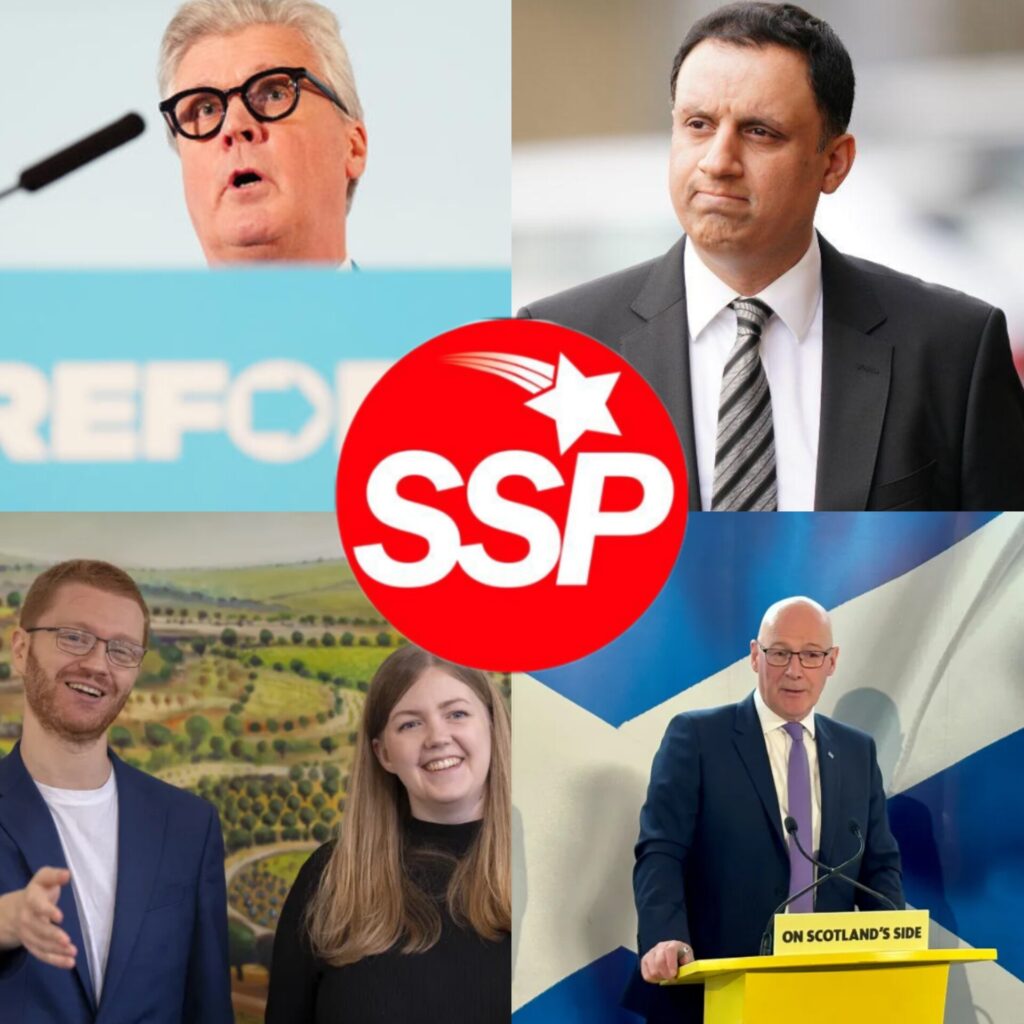
THE STRUGGLE CONTINUES – PART 1
A feature on the Scottish Election and its aftermath
By Richie Venton, SSP election campaign organiser
We are carrying a series of articles, making up this feature, written two days after the Holyrood election results. This first piece analyses the election overall, exploring the campaigns run by each of the mainstream capitalist parties and examining their performance.
“Don’t cry on camera!”
That was the advice of Labour apparatchiks to the hapless bands of Labour councillors and other activists traipsing into the election counts across the UK.
A brutal reminder of the bloody nose voters gave Keir Starmer and Anas Sarwar’s Labour, particularly in areas of multiple deprivation, with bitter rage against Labour’s betrayals and failure to address the unliveable conditions facing millions of working-class people. Not for the first time in recent elections, anger at Labour’s betrayal — and the dishwater dullness of other pro-capitalist alternatives like the SNP — was expressed by millions turning their backs on the entire election, refusing to vote.
Millions of others lashed out at the Labour government, less than two years after it claimed a landslide majority, by defecting to left and right. In Wales, which Labour has dominated like a one-party state for a century, they were battered into third place by the victorious Plaid Cymru and a surge for Reform UK, winning just nine out of 96 seats in the Senedd — in the land of miners’ strikes, general strikes, Aneurin Bevan, and workers’ insurrections of past times. In England, Reform were the biggest beneficiaries of the exodus from Labour in the deindustrialized, impoverished communities of the North and Midlands especially, whereas the Greens gained about 400 new councillors, particularly in London and the South.
Not a recipe for SNP stability
On the surface, the fact the SNP incumbents won a remarkable fifth term of office — something not even Margaret Thatcher’s Tories could achieve in their 18 years of Westminster rule (1979-1997) — looks like a remarkable demonstration of political stability. Digging a little deeper, it’s nothing of the kind.
For starters, nearly half those registered to vote — 47% — turned their backs on all the highly publicised party offers, as advertised in the mass media, staying at home on election day. That’s a fall of 10 points compared with the 2021 Holyrood elections.
Furthermore, there was a class differential in turnout. It’s noticeable that even within this low level of voter engagement nationally, the two worst regions were Glasgow and the North East — and within Glasgow a mere 40% voted in hard-hit Springburn/Easterhouse, in contrast to 55% in some better-off districts.
Negative campaigning
On top of that, every one of the major parties called on people to vote for them against a bogeyman, rather than put forward a positive agenda of any substance from themselves.
Not only the SNP and Labour but also the Scottish Greens focused heavily on the message “vote for us to keep out Reform UK”. Labour combined that with their call to oust the SNP after “20 years of failure”.
Indeed, the only party which concentrated on a radical, positive vision to transform the lives of millions was us, the SSP, with our hard-hitting Socialist Action Plan to raise incomes, cut household bills and vastly improve universal public services — by taxing the millionaires and taking the core of the economy into democratic public ownership.
However, that message barely saw the light of day in the mass media, with a couple of honourable exceptions like The National and some local papers.
Loss of support for the ‘winners’
They held onto office, but the SNP’s vote fell by 9.5% in the local constituencies (a loss of 400,000 votes compared with 2021) and crashed by 13.2% (468,000 votes down) in the regional list votes.
There was no enthusiasm for the SNP: it was more a begrudging vote to “keep Reform UK out” or “keep Labour out” for a big proportion of SNP voters — along with a desire for independence.
625,000 SNP regional list votes were wasted, electing just one SNP MSP, helping unionist MSPs win, because their narrow party self-interest prevailed over any wish to maximise the pro-independence vote, with their ‘Both votes SNP’ strategy.
Scottish Labour in permanent retreat Scottish Labour is locked into permanent retreat, losing support in every successive Holyrood election since the parliament’s formation in 1999, this time with a devastating reduction in their vote, reduced to 17 MSPs out of 129.
As we warned in 2024, when Anas Sarwar was strutting around with deluded notions of becoming First Minister — after the anti-Tory revolt elected Starmer’s government, vastly boosting the number of Labour MPs from Scotland — being tied to the British state and the fortunes of the British Labour government leaves Scottish Labour in a state of accelerating existential crises. There are public calls from within its ranks for Sarwar and deputy leader Jackie Baillie to resign.
And that’s before the ructions and ruptures between Labour and their century-old trade union affiliates explode, in response to serialised betrayals of any faint hope workers had of progressive ‘change’ under Starmer, and the active strike-breaking by Birmingham Labour council and UK Labour government during the year-long bin workers’ strike — including by alleged ‘left’ contender for the crown, Angela Rayner.
Fragmentation of politics
The SNP hung onto government office in large part because the unionist camp was more fragmented than ever, with the rise of Reform UK. The latter — racist, arch-Thatcherite Tory extremists — won a bridgehead in the Scottish Parliament primarily due to mass defections by Tory voters, but also a slice of Labour and even some former SNP voters. In parts of Scotland and the UK, Reform UK’s success was not so much straight defections from Labour to Reform, but more because ex-Labour voters decided to give the Greens a chance — especially with Zack Polanski’s turn to social issues and anti-capitalist rhetoric — which further reduced Labour’s share.
This election is probably the most fragmented in a century, with unprecedented numbers of parties and candidates competing and over half of those who turned out voting for two different parties.
As Professor Ailsa Henderson of Edinburgh University put it, “this election was the most volatile election we’ve ever had, twice as volatile as that of 2011.”
What now for Scottish Green easy riders?
The Scottish Greens won a big breakthrough predominantly in areas with large student numbers, Muslim voters enraged by the criminal genocide in Gaza, and enclaves with larger middle-class populations. They also gained from discontent with the SNP.
The Scottish Greens enjoyed massive coverage, some of it effusive, with outright recommendation by columnists in big sections of the media.
Compared with the SSP, they had the advantage of existing MSPs, leading many in the media to give them airtime while entirely blanking out the Scottish Socialist Party.
Many people who identified themselves as socialists voted Scottish Green, even though they openly told us they support us and the socialist policies we’ve advocated. For instance, we met several (particularly younger) people even on election day, who approached SSP street stalls saying that they’d “voted Scottish Greens to keep out Reform” but asked to join the SSP, or attend one of our meetings.
Judge them by their deeds, not words
Thousands like them heard the Greens talk about taxing the wealthy and claiming to be an eco-socialist party. They were never exposed by the mass media for their actual track record of repeatedly voting for austerity budgets, hand-in[1]hand with the SNP; of jointly abandoning the promise of a public energy company with their SNP coalition partners in 2021; of selling off Scotland’s seabed in the ScotWind bargain basement auction to BP, Shell and other multinational polluters in 2022, which lost £5.5bn a year, that could have accrued to the Scottish Government if instead these giant offshore wind farms were taken into public ownership; nor the fact that while in coalition, the Greens went along with SNP subsidies to arms companies profiting from war in general, the Gaza genocide in particular.